Wednesday, November 7, 2018

The Six Factors For Strategic HR

Today, organizations are working in a challenging environment. They are constantly changing and transforming in a short time with intense competition at the local, regional and global levels to achieve customer and stakeholders expectations in innovative and cost-effective ways.

In order for the organization to deal with these challenges and requirements, the six elements are used to achieve the required change. If the organization succeeds in formulating the six elements within a clear vision and a true change, it will be organization breakthrough and if it fails to do so then it will be huge loss.

The six elements are:

- A common vision: that the vision of the institution be clear and common among all sectors and that all employees know and believe in.

- Accounting: Any employee should be an important or his accountant on his responsibilities and duties without prejudice.

- Integration of partners: The identification of persons from within and outside the institution concerned with change and their integration into the process from the outset.

- Identify capabilities: Identify the knowledge, skills and behaviors required within a clear training plan and individual development programs.

- To promote the desired behavior pattern: Leadership in the same way as the leaders and officials of the institution are committed to the behaviors and change required to be role models and strengthen the employees' practice.

- Procedures, policies and measurement standards: Functional and behavioral procedures and policies are updated to adopt the desired change and promote its practice and non-disruption of staff.

In view of the six elements, we will find that regardless of who is assigned to be responsible for the management of the project and the team and their specialties, all six elements are included in the core HR strategy and operations of any organization and the lack of strategic human resources weaken the team and the project manager because they specialize in managing the operations of their departments and not about the organization system, culture and environment of the work and the psychology of employees and their impact on what is required and their conviction and impact on them and the extent of integration and support for change because it is the role of strategic human resources.

Therefore, studies have shown that 70% of organizations fail to achieve their vision or strategy because they do not know how to deal with the human element as it deals with operations and finances. This is the result of not adopting strategic human resources specialized in this important element for the success of any organization.


Monday, November 5, 2018

HR Insightful Eye

In many organizations there are a conflict between what is published in the newspapers and social media and between orgamization work reality and staff satisfaction in the organization.

The difference in reality from the public impression in the society about the organization results from the media and public relation  channels organization use to market to society about the organization imag from the vision, mission, plans, programs and achievements, but in reality the leaders of the organization actually practice something different and far away from what its publishng reagarding decision making, leadership style, communication, managing people, this is the real thing happening which known as organizational culture.

Organizational culture is the practice of  employees norms, values, believes and interests in the organization based on the supported by the leaders, the picture shows how the leaders of the organization create an internal culture, either its supportive of the public image known in society or its the enhanced version.

Organizational culture can work in both side, either its positive to support sustainbility, productivity and excellent performance of the organization, or it could be negative making work environmet unhealthy, demotivate employees and the reason for the organization to fall apart for competitors positive organizational culture, in the end what makes or breaks organizations are employees and what makes or breaks employees is organizational culture. 

Monitoring organizational culture and its impact on employees and organization stakeholders is not the job of the financ8al chief officer or sales or marketing managers because it is one of human resorces competency  to assist leaders craft, shape, manage, monitor and change  organizational culture to make sure if it is positive and supportive or it is negative, losing this monitoring by HR will result in thrrating the organization existing and losing to competitors. 


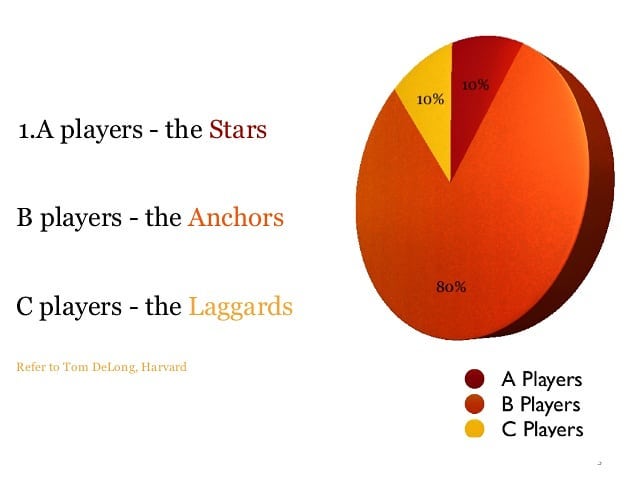
B Is The New A Players In Organization

Usually organizations focuses on outstanding performers who have the talent, skills, ability to achieve goals and meet the challenges they are known as A players.

Then come the category of experienced and skilled, who have the ability and probability to achieve the goals and possess a certain amount of knowledge and often achieve a proportion of expectations they are known as B players.

Then comes the category of low performers who lack the experience and skills to perform the work or have a pattern of thinking that generates negative behavior towards work and achievement of goals or may be miss matched with work in the first place and they are known as as C players.

These classification are known by there is nothing new in them but organizations that practice automatic behavior by focusing on the segment of excellence in achieving the goals which is A players they represent the smallest segment from the employee and this is often at the expense of the larger segment and they have the ability to be distinguish which is B players. Thus, the organization will limit its ability to excel by focusing on few especially that the winners often get attractive offers and leave a vacant in the otganization that need to be recruited which meean more costs, in addition exhaustion the top performers to achieve results will lead to unhealthy work envioronment and they might leave or worse be stressed. 

On the other side poor performance are neglected by the organization and try to pressure and threats to raise the level of performance and do not look at the reasons that can be resolved to turn into a high performance by care, attention, support and right guidance, which will result in activating more capabilities also being the smallest segment they usually been neglected  and this turn to affecting the detriment of the rest of the employees and the work environment of the organization and wasting resources .

Conclusion B players is the real organization investment, the successor of A players, and the solution of C players' problems, which saves organizations resources and reduces conflicts and conflicts in the workplace.


Sunday, November 4, 2018

Organization Hidden Wealth

We know that in the world of technology and communication, it is easy to deal with information, store and classify it. It is also a trade. Many organizations buy information for the purpose of achieving their goals. Many of the results of studies and research are based on information.

What is new regarding this topic, that organization has a wealth of knowledge as well accumulated over the years, which is the wealth that the global organizations benefits to develop their competitive advantage, core competency, creating new methodologies and tools of thinking and creativity because most of the methods of management, leadership, self development and other books and training courses come from the business world, so what is this wealth that organization ?

Human resources in the organization that responsible for their recruitment, training, performance management, integration of staff with twork environment, leadership development and other tasks, each of which collects information on important matters, for example in employment, measures the level of university graduates and their qualifications for the labor market. Skills and knowledge in training and performance Know what the employee and leader lack, methods and tools for improvement and development and so on.

The information stored in human resources is used by the global organization to work on bridging the deficiencies in the economic community, education, correcting the concepts and practices, and finding solutions to the labor market to qualify the society to lead and manage the organization and injecti new minds and skills to contribute to organization development, competitive advantage, core competency, creativity and innovation, leadership develooment. These are few of many positive aspects of human resources for any organization seeking development and change. These facts and value added HR contributiin are not less important than the financial statements, statistics and marketing studies.


Thursday, November 1, 2018

Employees Resist Change and Cause Organization Loss


In his book Practical People Engagement, Patrick Mayfield writes about how organizations succeed in bringing about the change they need, and achieve strategies, plans, programs, and goals.

The organization focus on formulating and designing strategies, objectives, plans and programs, and then inform the employees about them to implement them. The organization discover their lack of success and face difficulties, challenges and problems during implementation.

If you ask the leaders and managers of the foundation about the rehabilitation of employees will give you an answer that they did everything necessary for the staff to do the work, so why failed? They will say staff are the cause and resist change.

Mayfield developed the right action model for success as the first step to focus on Lean to People, which is to give the greatest amount of communication, dialogue and discussion, gain staff trust and interact with the influencers, the second step Lean to Action take action to make the desired change after communication and examine staff reactions to take action to deal with their point of view.

The two steps are aimed at deliver, which is the beginning of the change. The employees do not know anything about what has been formulated to help them gain their confidence and know more about what is being put up and how to use it, obtain the necessary skill to apply it routinely and comfortably.

Once again, the researchers prove the importance of human element in the organization and not the traditional based on we plan it and provide resources and employees  implemented, so the presence of strategic human resources in the organization is vital need for the success and continuity of the competition,  profits and survival of the organization in the global economy.


Tuesday, October 30, 2018

Successful Human Resources Manager

In the world of business, the responsibility of HR was to work on the administrative affairs of the organization and employees and carry out the routine transactions but with the development of the intensity of competition and change of organization work environment and performance, this role no longer meets the needs of the today organization and business world.

Today the responsibility of the HR manager and HR specialists is to contribute effectively to fulfilling vision, objectives and strategy of the organization, support employees and work environment and take into account external variables and internal requirements.

This shift requires HR manager and HR specialists be familiar:

- formulating and crafting vision.

- Strategic planning, managing strategy and formulation of objectives.

- Financial practices and methods of calculating the return on investment.

- The art of enterprise management in the and requirements of competitive environment .

- Change management.

- The nature of the organization's stakeholders, customers expectation, products and services and how to reflect it in HR strategy and deliverable services to support business units achieving 

- Various measurement tools, financial, quality, statistical and employment methods to support the employees and the organization.

-  Research and obtain successful methodologies and practices to support, recruit, encourage and inspire employees talents, performance and creativity at work.

HR manager and HR specialist today requires to be familiar with these various sciences and practices employed in the formulation of strategy and objectives of HR to deliver services support achieving the vision, strategy and objectives of the organization and measure the results of HR contribution in f8nancial figures and statistics showing how much HR contributiin in profit, meet customers expectation, maintain organization core competency, organization competative advantages and sustain employees talent and creativity at work. 


HR And Organization Vision

How do you know that an organization has a vision?

Vision and mission are among the most important elements of the successful organization today because it contributes to determine the course of the organization and the participation of human capital in achieving it.

Most organizations suffer from difficulties and obstacles in their strategies and objectives despite the existence of a vision and mission that negatively affect the achievement of tangible  added value results and not wasting the of organization resourcrs, talents, competencies and efforts of employees in non productive and useful work, but most organizations keep busy in solving crises and accumulated problems which stopped the cont8nues development and change.

Why organizations  face difficulties although they have with vision and a mission? To assess that the organization has the right vision or just a constructive speech, we need to verify that the vision has:

1 - Imagination / photographer: In the sense can be read to see the perception in his mind how the future will be enthusiastic and it is living today.

2 - Desirable: meaning that is what everyone wants to share it and not desire permeated.

3 - Possible: applicable to available conditions and resources, phased in with possible targets and measurements.

4 - Concentrate: Put everyone in one direction and do not distract efforts or leave room for argument.

5 - Flexible: be adjustable in the stages of application with changing conditions without loss of orientation and vision itself.

6 - Can be explained and understood within five minutes.

These are the elements for the right vision and if any of these elements missed the vision become more of speech and fancy words that is difficult to achieve than a vision, which leads to confusion and lack of success of organization in achieving, employees participation and understanding of their role in realizing the vision.

HR as strategic partner plays an important role in formulating and crafting organization vision and mission, align organizational resources, core competency, employees competencies and talents, organizational culture, organization systems, processes and architect organizational structure to fulfill the vision, since at the end realizing the vision depends on human ability to formulate and craft right vision and adopt and excute it in the right way by human abilities as well.